We Don’t Need to “Solve” Slow Play. We Need to Sort It.
Pace of play is the most-discussed and least-resolved problem in golf. The conventional framing — that slow play is a handicap problem to be cured by better behavior — collapses the moment the data is asked to defend it. Habit, not handicap, runs the clock. And the operator’s P&L quietly disagrees with the editorial consensus that pace should be enforced.
Pace of play is the most-discussed and least-resolved problem in golf. Every operator complains about it. Every golfer blames the group ahead. Every ranger is asked to enforce a target that the business model itself quietly undermines. After forty years of editorial hand-wringing, the average round of golf at a public course is longer than it was in 1985.
The conventional framing has been that slow play is a handicap problem — that golfers, especially less-skilled ones, are doing something wrong, and that if they would simply “play better,” the problem would resolve.
We tested that framing against assessment data from the MyGolfType platform. What the data says is that the framing is wrong, and that pace-of-play discourse has been arguing about the wrong variable for decades. The primary determinant of pace is not skill. It is habit. And once that is true, the fix is not behavioral reform. It is sorting.
Handicap Is Not the Signal
Across MyGolfType assessments, the relationship between handicap and pace of play is statistically close to nothing. A near-scratch golfer is roughly as likely to be a slow player as a 25-handicap is. A 22-handicap is roughly as likely to be a fast player as a 9 is. The cloud of golfers on a handicap-versus-pace plot is essentially a cloud — it has no slope.
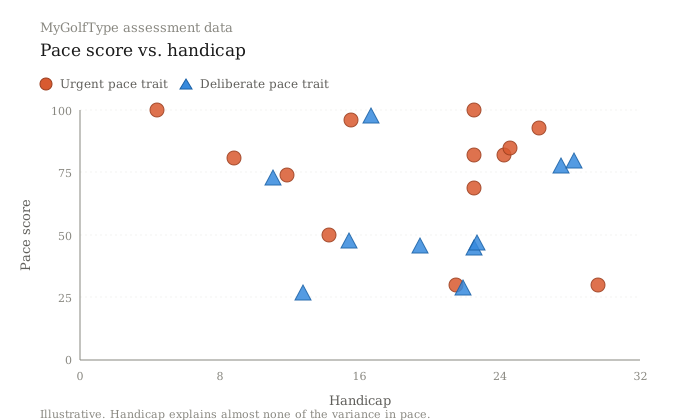
The dominant narrative — that better players play faster because they are better — is a feature of country club populations, where the players who carry indexes also happen to be the ones who play frequently enough to have developed efficient routines. It does not generalize to the playing population at large.
Habit, Not Handicap
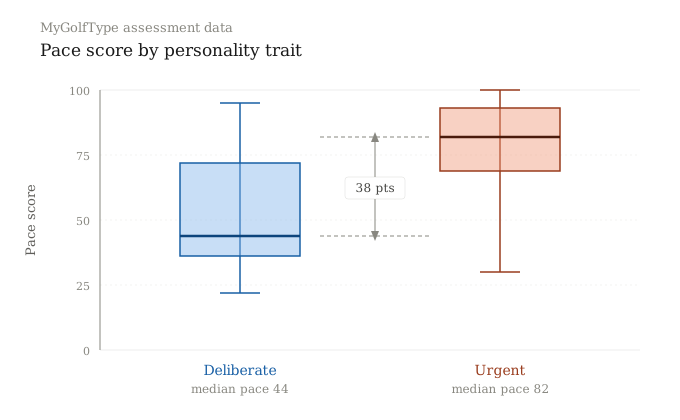
Every MyGolfType assessment captures a pace trait independently of skill. Every question — no matter the focus — extracts a piece of a pace puzzle. Some players are Urgent — they walk ahead while their partner is hitting, they pull a number to the pin and execute, they rake gimmes, they take a drop and move on. Some players are Deliberate — they wait their turn, they pull front-middle-back, they read every putt from three sides, they find golf balls others have written off.
Neither disposition is wrong. Both are thoroughly defensible expressions of why someone plays golf in the first place. But they produce dramatically different round durations.
Why the Standard Advice Has Always Felt Off-Target
The 17.7% of golfers who carry a USGA handicap are not representative of the playing population. They are a self-selecting sliver — country club members, tournament players, and the small share of public-course golfers willing to pay $50 a year to track a number. The genuinely sub-10 handicap is rarer still: credible industry estimates put it at roughly 3–5% of all golfers.
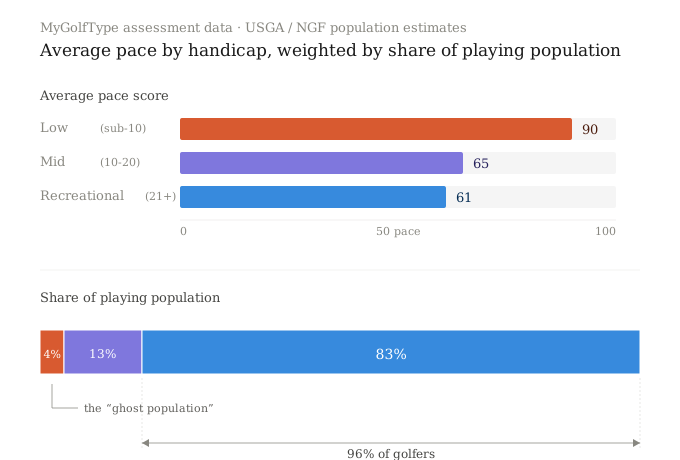
That sub-10 population is also disproportionately Urgent. The two compound. Players who got good at golf tended to be people who were efficient with their time on the course; their urgency expressed itself, over years, in fewer wasted shots. They are fast not because they are good, but they are fast and good for overlapping reasons.
Most pace-of-play discourse has been written by, for, and about the 5%. Within that world, “play better and you will play faster” is approximately true, because skill and urgency are correlated inside that population. Generalized to the other 95%, the instruction stops working — because skill and pace decouple almost entirely.
Some Slow Play Is Profitable
Here is where the investigation turns from data toward business model. Because even if every public course implemented a perfect pace-enforcement program tomorrow, the courses’ own profit-and-loss statements would object.
A golf course operator has at least four interests that compete with pace of play:
- Food and beverage revenue. The group that stops at the turn for a sandwich and two beers is not the group the operator wants to chase off the property. They are the group keeping the F&B operation viable.
- Tee sheet density. The operator is not selective about who books. A full sheet of mixed-pace groups generates more revenue than a thin sheet of fast groups.
- Ranger diplomacy. Every group the ranger meaningfully scolds is a group statistically less likely to rebook. The ranger’s actual job is to straddle a line — sheepdog and emissary at once.
- The social value proposition of golf. Across MyGolfType assessments, the “Social Energy” trait splits almost exactly down the middle between Focused and Social. Half of golfers are out there for the same reason they go to bars, parties, and festivals — for the interactions. That half plays slower. They are also the half most likely to come back.
Which is why the standard editorial demand — enforce pace, fix the problem — has never been adopted at scale. The operators who would have to enforce it are economically disincentivized to. The problem isn’t that they’re failing to act on a clear answer. The problem is that the answer is in tension with the business.
A Sorting Problem, Not a Behavior Problem
If habit is the variable that matters, and the operator can’t ask players to be different without losing revenue, the question changes. It stops being how do we make slow players fast and becomes how do we position every golfer, every cart, every group so that none are impediments to any other?
That question has an answer, and the answer is operational rather than moral.
The MyGolfType PairWise system extracts every golfer’s pace profile alongside their personality. It pairs each golfer with a cart-mate whose disposition is genuinely compatible. It pairs each cart with another cart whose pace complements rather than collides with it. And then it stacks the tee sheet by pace descending — fast groups out first, deliberate groups behind them, each group in front of one that will not be impatient with it.
This is not a behavioral intervention. Nobody is asked to play differently. The Deliberate player gets a round with cart-mates who appreciate the same things they do. The Urgent player gets a round in front of the Deliberate player, where their pace is not punished. The operator gets a tee sheet that produces the same total revenue from F&B, the same density, and the same accommodating culture — but without the structural friction that creates four-and-a-half-hour rounds and rebooking complaints.
What the Evidence Actually Supports
The accusation this investigation set out to test was that slow play is a behavioral problem with a behavioral fix. On the data, that framing does not hold up.
What the data supports is something more structural:
- Habit is the dominant variable. The Urgent/Deliberate pace trait predicts round duration far better than handicap does, across nearly the entire skill curve.
- The skill effect is real but narrow. Low-handicap players really do play faster — but they are 3–5% of the playing population, and most of them are already fast for reasons that have more to do with personality than with handicap. Optimizing the tee sheet around them would be optimizing around a ghost.
- Operator incentives push against pace enforcement. F&B revenue, tee sheet density, diplomacy, and the social value of golf all point the same direction — toward tolerating a wider band of pace than the editorial consensus would prefer.
- The structural fix is sequencing, not reform. A sorted tee sheet — by pace descending, with compatible cart pairings inside groups — produces a course where slow play exists but does not impede. Nobody is asked to play against their nature. The friction is removed by arrangement, not by instruction.
- The conventional pace-of-play discourse has been arguing inside a country club. Generalized to the public-course majority, “play better and you’ll play faster” doesn’t describe a mechanism. It describes a correlation inside a sliver.
Pace of play is not a problem to be solved. It is a sorting problem to be arranged. The slow player is not playing wrong; they are playing as themselves, and so is the fast player, and the operator profits from both. The course that figures this out first will not have eliminated slow play. It will have made slow play invisible to everyone it would otherwise have inconvenienced — including the slow players themselves, who get to enjoy their round at their pace, in the company of people who play the same way.
I honestly don’t mind if you’re the Indiana Jones of finding lost golf balls.
So long as you’re doing it in the group behind me.
Assessment data. Pace and personality scoring drawn from the MyGolfType assessment platform. The platform captures a “Pace” trait independently of personality and skill, allowing for direct comparison across handicap buckets. Sample composition and assessment volume are not disclosed in this article; readers interested in the underlying methodology can review the assessment framework at mygolftype.com/compatibility-matrix.
Handicap population estimates. The 17.7% USGA-indexed population figure is drawn from USGA participation reports. Sub-10 handicap prevalence (3–5% of all golfers) is derived from triangulation of USGA index distribution data, National Golf Foundation participation surveys, and operator reporting.
Disclosure. This investigation faces the platform that produced it. Prior investigations from MyType Publications faced the industry at large. The conflict-of-interest direction is acknowledged: the data source is also a commercial product, and the conclusion the data points toward is a product feature. Readers should weight that accordingly. The findings on habit-versus-handicap are presented as observation; the case for sorting as a solution is presented as argument.
What this investigation could not do. Test the sorting hypothesis at scale at a public course in a controlled study. Verify pace impact at the cart-pairing level versus the group-pairing level versus the tee-sheet level. Account for variation in course-specific factors (rough density, walk-up distances, par configuration) that interact with personality-driven pace in ways the assessment data does not directly model.